Štruklji & Damp dumplings – recipes
Together with the Uncommon Fruits team, we invited Nonna Maria to host us in her kitchen for a shared cooking session. The idea was to exchange two recipes that feature dried fruits and nuts—ingredients commonly used in late autumn and winter cooking across the Alpe-Adria region. We wanted to explore how similar ingredients and techniques appear in different food traditions, and how recipes can blur the lines between nationalities and geographical borders. We had long hoped to learn how to make štruklji with Nonna Maria, known in the valley for making some of the best. In return, we brought a recipe from Philipp’s Austrian grandmother: steamed yeast dumplings filled with reduced plums, topped with poppy seeds floating in brown butter.
Video: Antônio Frederico Lasalvia
Recipes
Dampf dumplings
ERBA
250 g strong flour / 500 g / 1 kg
21 g yeast (alternatively 7 g dry yeast) / 42g / 84 g
125 ml warm milk (+ a dash for the cooking water) 250ml / 500ml
30 g sugar / 60 g / 120g
1 pinch of salt / 2 pinches / 4 pinches
2 egg yolks / 4 egg yolks / 8 egg yolks
25 g butter / 50g / 100g
6 tbsp Powidl / 12g / 24g
50 g butter/ 100g / 200g
3 tbsp poppy seeds (ground)
3 tbsp icing sugar
Tips
→ With fresh yeast you always have to pay attention to the expiration date, it always reacts differently depending on its age.
→ The shaping works by rolling a ball on a floured board with the palm of your hand. The circular movement makes the surface nice and smooth.
→ Real Powidl is only made from plums, without sugar and without rum. You can use a generous spoonful per dumpling.
→ Place the dumplings on an oiled tray so that they do not stick and cover loosely with a kitchen towel or cling film so that the dough does not dry out.
→ Do not let them rise completely, otherwise they will collapse when you pick them up.
→ The milk makes the steam sweet, which makes the dumplings better. Only water leaches out the dumplings and they taste a bit bland
→ Mix the ground poppy seeds with icing sugar in a ratio of 1:1.
Instructions
1. Crumble the yeast into the milk in a bowl and mix with 50 g of plain flour. Sprinkle with a little flour, cover the bowl with a damp towel and let the “Dampferl/Predough” rise for 15-20 minutes.
It's ready to be used further if foam collects on the surface of the milk.
2. Buttercream > Beat the melted butter in a small bowl with icing sugar until the sugar is fully dissolved, add egg yolks,salt and whip over steam until it reaches 62 degrees. Make sure to not overheat and the egg yolk becomes flaky
3.Combine everything,knead flour and the butter mixture to form a soft, smooth dough. Knead until smooth texture.
4. Divide the dough into 4 equal-sized pieces and shape them into balls. Cover the dough balls with a damp cloth and leave to rise for 30 minutes.
5. Knead the balls briefly and flatten them with your hands. Put a teaspoon of Powidl in the middle of each one, fold the dough over it and press firmly. Place the dumplings with the pressed part facing down on a board sprinkled with flour, cover with a cloth and leave to rise for another 30 minutes.
6. Boil water in a heavy pot, add the dumplings in a steaming basket and cover. Steam over a low heat for around 15/20 minutes. They should at least double in size !
7. Immediately place the dumplings on hot plates. Pour hot, melted butter over them and sprinkle with poppy seeds and powdered sugar.
- - - -
Maria Gilda’s Cooked Štruklji
Notes by Dora
Dough
4 white potatoes, boiled in unsalted water, peeled and mashed twice (this should be done while still warm, then a pinch of salt is added).
5 handfuls of flour are combined with the potatoes to form a soft dough, which is then left to rest.
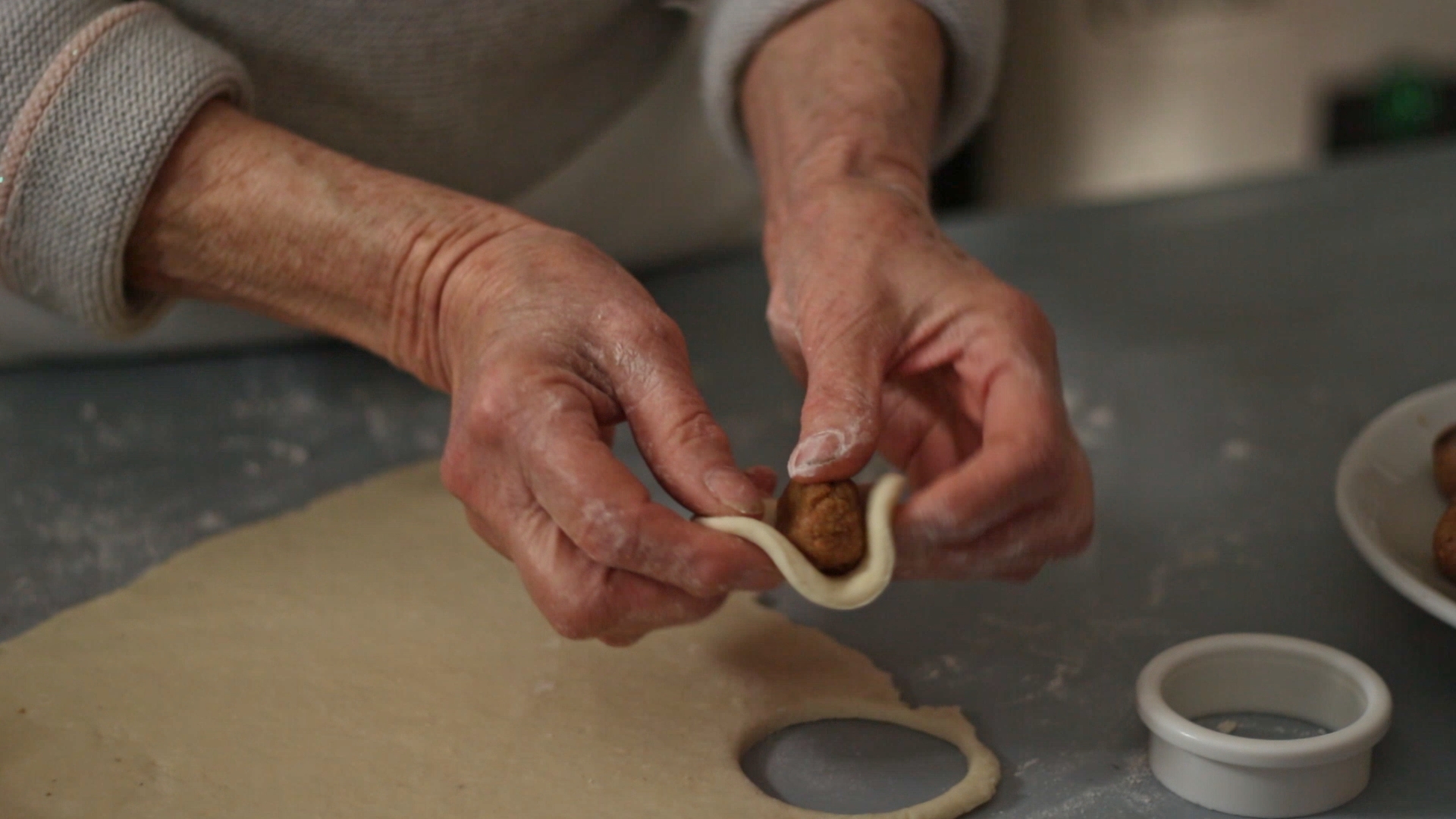
Roll out the dough to a thickness of about 3 mm (or, if you want to make the butterfly-style closure, roll it out to about 2 mm).*
Gubančanje (filling)
4 handfuls of walnuts**, crushed with a rolling pin between two sheets of baking paper and then blended in a mixer together with dry biscuits (or amaretti) and 4 handfuls of breadcrumbs toasted in butter (without crust).
At the end, add pine nuts (in a smaller quantity than for gubana), sautéed in butter; 1 tablespoon of sugar; raisins soaked in grappa or rinsed; plus 5 tablespoons of rum punch (or rum), 3 tablespoons of egg liqueur (marsala), and 2 tablespoons of grappa (preferably plum or pear).
From the gubančanje filling, form compact balls about 1.5 cm in diameter.
Closing and cooking
Form discs of dough about 10 cm in diameter and place one filling ball in the center. Close the edges of the dough, making sure to seal them well together, then press gently with a finger in the middle of the closure (without using the fingernail, to avoid tearing the dough), thus giving the štruklji a candy- or butterfly-like shape.
Bring salted water slowly to a boil and immerse the štruklji for 2 minutes. Remove them one by one with a slotted spoon and dress them on the plate with yellow, “German-style” clear butter (melted and skimmed) and a little sugar.
* With a young moon, the dough turns out more watery.
** If the walnuts are not good or slightly rancid, wash them three times and let them dry. A little almond-based liqueur (Disaronno) can also be added to adjust the flavor.
Notes from local recipes
San Leonardo/Podutana: potatoes were always used in the dough.
Savogna/Sovodnje: lukewarm water was used in the dough instead of potatoes.
Grimacco/Garmak: cold water was used, without potatoes.
Vernasso/Barnas: bread and milk were added to the dough.
Drenchia/Dreka: the štruklji were larger in size and potatoes were not used in the dough.